When Is Building Monitoring Needed?
Find out when structural monitoring is required or recommended — legal requirements, variable loads, ageing structures and construction in the vicinity.
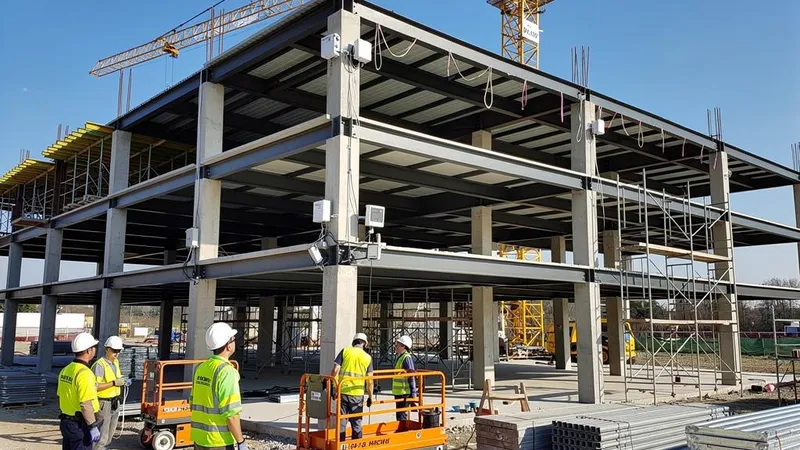
Not every building requires structural monitoring — but in many cases it is mandatory or strongly recommended. In this article, we explain when building monitoring is needed, what situations require it and how to assess whether your structure should be monitored.
When is monitoring legally required?
Polish building law does not contain a single regulation mandating monitoring for every structure. However, the obligation arises from several sources:
Technical Conditions — § 204(7)
The most important provision is § 204(7) of the Regulation of the Minister of Infrastructure on the technical conditions to be met by buildings and their location (Journal of Laws 2022, item 1225):
“Public buildings with rooms designed for large numbers of people, such as: entertainment halls, sports halls, exhibition halls, trade halls, shopping centres and railway stations, should be equipped, as needed, with devices for continuous monitoring of parameters critical to structural safety, such as: displacements, deformations and stresses in the structure.”
In practice, this means that sports halls, stadiums, shopping centres, railway stations and entertainment venues should have a permanent structural monitoring system. The phrase “as needed” leaves some margin for interpretation, but for structures with large spans and significant live loads, monitoring is the standard.
Building project and functional brief
The most common reason for implementing monitoring is a requirement in the building project or the Functional and Operational Programme (PFU). The structural designer may recommend monitoring when:
- the structure has a large span (e.g. stadium or hall roof)
- the design uses innovative materials or structural solutions
- the structure will be exposed to variable loads (wind, snow, crowds)
- the structure is lightweight and sensitive to dynamic effects
In such cases, monitoring becomes part of the project and is required for the occupancy permit.
Building supervision authority decision
A district or regional building inspector may order monitoring of an existing structure when:
- structural damage has been found (cracks, corrosion, deflections)
- the structure has undergone a conversion changing the structural scheme
- a safety complaint has been received
- a construction failure or disaster has occurred nearby
Heritage conservator requirements
Buildings listed on the heritage register are subject to special protection. The heritage conservator may require monitoring when:
- renovation or adaptation works are planned
- the building shows progressive damage (cracks, settlement)
- construction works in the vicinity may affect the listed building
When is monitoring recommended, though not required?
Even without a formal obligation, structural monitoring is strongly recommended in the following situations:
Large-span structures
Roofs of halls, stadiums, amphitheatres and shopping centres with spans exceeding 20–30 metres are structures where even a slight deviation from design assumptions can lead to catastrophe. Monitoring allows continuous verification that actual loads and deformations remain within acceptable limits.
Structures exposed to variable loads
Buildings and structures exposed to:
- snow loads — especially flat or low-pitch roofs in high-snowfall regions
- wind loads — tall, exposed structures or those with large lateral surfaces
- dynamic loads — bridges, viaducts, structures exposed to vibrations from vehicle traffic
Monitoring tracks how the structure responds to variable loads and whether fatigue damage is accumulating.
Buildings in construction impact zones
When the following are being carried out near an existing building:
- excavations — especially deep ones near foundations
- pile driving or sheet piling — generating vibrations
- demolitions — which may change ground conditions
In such cases, monitoring of neighbouring buildings (so-called baseline monitoring) documents the structural condition before works begin and detects any damage caused by the construction.
Ageing structures
Buildings and engineering structures that:
- are over 30–40 years old and have not been thoroughly renovated
- show visible signs of wear (steel corrosion, concrete carbonation, cracks)
- have had their use changed (increased loads, added storeys)
Monitoring assesses the current condition and rate of degradation — this is the basis for renovation or reinforcement decisions.
Buildings after failures or disasters
After a fire, flooding, earthquake or structural failure, the structure may appear intact but have hidden damage. Post-event monitoring allows:
- verification of whether the structure is safe for continued use
- tracking whether deformations or settlement are progressing
- providing data for technical expert assessments
How to assess whether your structure needs monitoring?
The following questions will help you make an initial assessment:
- Does the building project or brief specify monitoring? — if so, it is a formal requirement
- Does the structure have a large span (>20 m)? — the larger the span, the greater the risk
- Is the structure exposed to variable loads? — wind, snow, crowds, vehicle traffic
- Are construction works being carried out or planned nearby? — baseline monitoring
- Is the building over 30 years old or showing visible damage? — diagnostic monitoring
- Has the building’s use changed? — new loads may exceed design assumptions
A “yes” to one or more questions is a signal that monitoring is at least worth considering.
What does monitoring deliver in practice?
Monitoring systems are not just a formal requirement — they are a tool that genuinely improves safety and saves money:
- Early problem detection — before a small crack becomes serious damage
- Data-driven decision making — not based on annual visual inspections
- Maintenance cost optimisation — you repair what actually needs it
- Documentation for insurers — monitoring data as evidence of proper building maintenance
- Peace of mind and user safety — especially in public buildings
Summary
Building monitoring is needed wherever structural safety cannot rely solely on periodic inspections. Large-span structures, those exposed to variable loads, those in construction impact zones, or those with visible damage — these are the main cases where monitoring is required or strongly recommended.
If you’re unsure whether your structure needs monitoring — get in touch. We’ll analyse the documentation and recommend the optimal solution.